
Origin of the Universe: The Big Bang
It is easier to believe that there was nothing before there was something than that there was something before there was nothing.”― Julian Huxley
Complexity is difficult for our brains to comprehend and rationalise. We try to simplify complex concepts by relating them to something simpler, but the cosmos is not so simple.
Once upon a time, our Milky Way Galaxy was supposed to contain the whole known universe. But our universe now contains billions of galaxies, and its origins may be traced all the way back to the Big Bang.
The Origin of the Universe: The Big Bang
Since the early 1900s, one hypothesis for the universe's origin and fate, the Big Bang theory, has dominated the debate. The Big Bang - an explosion of space itself - was the beginning of our cosmos. Space expanded, the cosmos cooled, and the simplest elements created, starting from extraordinarily high density and temperature. Gravity brought materials together throughout time to make the earliest stars, then stars died in an explosion called Supernova, but their chemical leftovers gave birth to new generations of stars and allowed the formation of rocky planets. Life evolved to consciousness on at least one of these planets.
How Lumpy Do You Like Your Universe?
The Big Bang model, on the other hand, is not universally accepted. The hypothesis has a flaw in that it promises a smooth universe. That is, on a broad scale, the distribution of matter should be essentially the same everywhere. There should be no excessive lumpiness in the universe.
However, in 2001, scientists announced the discovery of a cluster of galaxies and quasars that spans over 125 million cubic light-years and is currently the universe's largest structure. The universe appears to have large empty gaps punctuated by tightly packed streaks of matter, rather than a uniform distribution of matter.
Proponents of the Big Bang theory insist that their idea is not flawed. They claim that stuff is attracted to clumps by gravity from massive, undetected objects in space (clouds of cold, dark matter that can't be seen with telescopes, or so-called cosmic strings). Other astronomers, who are still hesitant to believe in invisible things in order to address an incomprehensible problem, continue to cast doubt on basic components of the Big Bang theory.
Despite its flaws, most astronomers still believe the Big Bang to be the best theory we have.
The End of the Universe
Will the universe keep expanding indefinitely? Will it simply come to a halt or maybe begin to contract? The answer is determined by the amount of mass in the cosmos. If the mass of the cosmos exceeds a critical threshold, gravity should eventually prevent everything from flying away from everything else.
The cosmos will someday succumb to gravity's tremendous force and collapse back into a single point if there is enough mass—a notion known as the Big Crunch. However, if there isn't enough mass in the cosmos, it will continue to expand. In 2001, many scientists came to the conclusion that the latter option was the most likely.
In 1998, scientists discovered an even more perplexing puzzle: the cosmos appears to be speeding up as it expands, as if dragged by some sort of "antigravity" force. Other astronomers have now used a number of approaches to validate this conclusion, effectively confirming the presence of this enigmatic "dark energy."
++++++++++++++++++++++++++++++++++++++++++++++++++++++++++++++++++++++++++++++++++
Meta Title:Origin of the Universe: The Big Bang, Universe- Space India
Meta description: Origin of the Universe: according to Big Bang theory, the universe began about 13.7 billion years ago, in a massive expansion that blew space up
Climate Change: A Threat to Mankind
More than fifty years of human activity in space have produced social blessings that enhance the quality of life on the Earth. The primary satellites, designed to look at the space environment and take a look at initial competencies in Earth orbit, contributed vital information and talents for developing satellite tv, telecommunications, global positioning, and advances in weather forecasting.
Space exploration initiated the economicdevelopment of space that nowadays, and also yearafter year, offers excessive returns for invested price range in space.
The challenges of space exploration have sparked new technological and scientific expertise of inherent value to humankind, mainly to better know about our Universe and the solar system wherein we stay. Information,coupled with ingenuity, presentspeople around the world with solutions in addition touseful services and products.
Space exploration brings new perspectives
Informationobtained from space exploration hasalso added new perspectives on us and collective vicinity in the Universe.
Change in climate and weather is emerging as one of the challenging period and demanding situations within the society. It's a great modification in long termweatherstylesparticularlycausedby greenhouse gases, which make the earthwarmer by using trapping energy in the environment. Worldwide emissions of greenhouse gases could grow by addition of 37% by 2030.
A warmer earth leads to changes in rainfall styles and clean water availability, rises in sea stage, and many effects on plants, flora &fauna and human activities. However, ahighlevel of uncertainty still attaches to the numerous predictions and the technology underlying them, as proven by way of the lengthy-status international scientific and political debate onthesetopics.
Thereis a sturdy interplay between climate change, human activities and the natural sources.Focussing on case research in water management, marine resources and maritime transport, it grows the necessity for growing satellite systemsto measure and control the adverse effects on the humanity and monitor weather, help to mitigate its consequences, and decrease the uncertainties that surround projections.
The function of area technologies, wide range of satellites and their ground tracking systems are ready in space. These range from meteorological satellites to telecommunication, navigation and earth observation satellites.
Space technologies mitigate the outcome of climate change
When NASA was turned up as the first agency of spaceby Aeronautics and space Act of 1958, it was given the function of developing technics for “space observations,” however it wasn’t given a function in Earth sciences. The organisation’s leaders embedded thetechnologyeffort in an Earth Observations program focused at the new Goddard Space Flight centerin Greenbelt, Maryland, in the U.S.
Now, satellites and different space technologies will be used to assist mitigate theoutcomesofclimate change, in addition to shield both animals and communities.Satellitetechnologyhas long been used to predict the weather, with meteorological forecastsableto act as early warning systems for severe weather occasions.
Thetechnology is also key for documentingenvironmental modifications and informingselection making by way of measuringsea levels, atmospheric gases and the planet’s changing temperature,among other elements.
Meteorological satellites have long been used to forecastexcessiveclimate occasions.Now, there are various frontier technologies are being usedtofightclimatechange.Thetechnologies can also be used to enhance agriculture and for tackling wildlife problems.
How satellites are useful according to World Economic Forum?
There are currently greater than 160 satellites measuring distinctive global warming signs, withgreaterthan half ofcritical weather variables most effective measurable fromspace,according to the WorldEconomic Forum.
-
Frontier technologies to tackle climate change
The arrival of frontier technology including space 2.0 systems, withdifferentinnovationswhich includes artificial intelligence (AI), 5G, the Internet of Things (IoT) androbotics, gives similarly capacity for helping the combat against climate change.
Information & Communication technology may want to play an essentialroleinmeetingthe Parisagreement’s target of restricting worldwide warming to at least 1.5C, in keeping with Frontier technologies to protect the environment and tackle the climate change, a joint report from the international Telecommunication Union and the United nations. Among those are Space 2.0 technology, which build on the ones evolved at some point of the first space age of 1957-2000. Space 1.0 led to technologies including the global Positioning gadget (GPS), whichbecamewidelyfollowed commercially.
- Satellites to find weather patterns
One such instance is NASA’s Ice, Cloud and land Elevation satellite(ICESat-2) spacecraft,which launched in 2018.ICESat-2’spredecessor confirmed the thinning of seaice andhow ice cover had disappeared from coastal elements of Greenland and Antarctica.NASA’s latest satellite evolved as a medium to provide greater facts on howice cover changes over the course of a year.Scientistsdesirethatrecordsfromnext-generation satellites which include ICESat2 – whichtakes measurementsevery85centimetres alongside its ground route, couldenhance forecasts forgrowingsealevels, in addition tointernationalclimateandclimatestyles.
- AI Cameras to monitor wildlife crime
Satellites have also been utilized in Africa tohelppreventmassiverecreationpoachers from killing protected species.US non-profit Resolvehasworked with United Kingdom satellite provider Inmarsat to broaden a Trailguard AIanti-poachingdigicammachine that enables country wide parks detect, stopandfind poachers.Checking out at Tanzania’s Grumeti Reserve caused the arrest of 30 poachers and the seizure of more than 590 kilogrammes of bushmeat.
- Sensors to track animals
The global Co-operation for Animal Research Using Space (Icarus) initiative is the use of a satellite at the international area Station (ISS) to create an “internet of animals”.
Scientist’s desire to find the migratory patterns of birds and animals from space with the resource of thumbnail-sized transmitters attached to their backs. Theinformationisthen beamed to the ISS, in which its miles transmitted to a ground station. The resulting synopsis ofanimal existence on the earth should later be used to transmitotherenvironmentalinformation.
- Satellite images shots transformed into statistics for farmers
Satellite imagery and weather statistics can also aid different sectors consisting of agriculture andenterprise, with extra benefits to the communities they serve.
DigitalEarth Africa uses Open Data Cube and Amazon Web Services to makeworldwidesatelliterecords, which is more accessible and highlight how it can be usedtobridge social andeconomic inequalities.Suchinformation can be used tohelpfarmers to improveagriculturalyield, thereby lowering hunger; tackle unregulated miningand its knock-onoutcomes;anddiscovernewpossibilitiesformonetaryincrease.
There is no activity on Earth that matches the unique challenges of space exploration. The first fifty years of space activity have generated benefits for people around the globe. This past record gives strong reason for confidence that renewed investments in space exploration will have similarly positive impacts for future generations.
++++++++++++++++++++++++++++++++++++++++++++++++++++++++++++++++++++++++++++++++++
Meta heading: Climate change: A threat to mankind – Space India
Meta description:Change in climate and weather is emerging as one of the challenging period and demanding situations within the society. Learn how Space technologies helps in reducing the damage of climate change.
Kalpana Chawla: An Indian Astronaut to Remember
“When you look at the stars and the galaxy, you feel that you are not just from any particular piece of land, but from the solar system.”
– Kalpana Chawla, at her first launch
A starry-eyed woman who imagined the world and brought that idea to life, Kalpana Chawla was born in Karnal, India, on March 17, 1962, and grew up in a family where her parents from Multan, Pakistan had moved to Karnal, Haryana. Perhaps it was a foregleam that made her parents name her "Kalpana", meaning "idea" or “imagination”, because while other girls of her age liked to play with dolls, Kalpana chose to draw &color planes and had a curious mind.
"She insisted on seeing a plane from close distance. That time we had the Karnal Flying Club a few kilometers away, so I contacted a senior officer there whom I had met a few months ago and he invited us to visit the Club.” Her father, Banarasi Lal Chawla, said in an interview.
Early Life of Kalpana Chawla
Being a bright child, Kalpana’s tendency was clear from the beginning. Focusing on the education of Kalpana Chawla, she completed her undergraduate studies at Tagore School, Karnal followed by an undergraduate degree in Aeronautical Engineering from Punjab Engineering College, Chandigarh.
After his bachelor's, considering the vast number of opportunities available in design, construction & research, and development in the USA, he moved to complete his master’s in the USA from the University of Texas in the 1980s. After that, he graduated with a doctorate in Aerospace Engineering from the University of Colorado in 1988 and progressed toward his bright dreams.
Career as Astronaut
Chawla began working at NASA's Ames Research Center, working on computational fluid dynamics. Later, in 1994, she was appointed astronaut and a representative of the Astronaut Office EVA team. After a few years of training, he was fully equipped with the skills and knowledge necessary to manage Robotic Situational Awareness Displays and to test space software.
She is an example of countless Indian women; she was an ordinary girl with long dreams and indestructible courage that made her the first Indian woman and the second Indian to fly in space.
Kalpana Chawla Space missions
For those who are wondering how many times Kalpana Chawla has gone into space, they will be surprised to know that she has completed 2 space Missions! Being the mission specialist and primary robotic arm reporter on her first flight Space Shuttle Columbia in 1997, Kalpana was the only woman who was part of the six-astronaut crew. Their space shuttle took over 250 orbits around the earth in just a span of two weeks. For the main purpose of studying the outer layer of the sun, the team performed many experiments apart from the deployment of a Spartan satellite from the shuttle.
In 2004, NASA dedicated a supercomputer to Kalpana at NASA Ames Research Center. It was the world’s first single-system Linus supercomputer.
Following this, Kalpana ventured for her second voyage into space with seven crew members including herself in STS-107 which was her last. The mission that was supposed to start in 2000 was often delayed and finally launched in 2003. During its 16-day voyage, the crew carried out more than 80 experiments and it was a successful mission when on the morning of 1 February 2003, the plane crashed as it entered Earth's atmosphere and no one survived in the disintegration. On February 01, 2003, she died.
For her career achievements and significant contribution to the country, Kalpana Chawla has received several awards including the prestigious NASA Distinguished Service Medal, the Congressional Space Medal of Honour, and the NASA Space Flight Medal.
With her 30 days, 14 hours, and 54 minutes in space during her two space missions, Kalpana explored the intricacies of space.
Kalpana's death was not in vain because several doors of opportunities were opened for others who wished to follow in her footsteps. She will be remembered as the first Indian woman who never let her racial background prevent her from setting foot in space. Kalpana’s greatest contribution to humankind was proving that every goal is attainable when there is an inextinguishable inner fire.
++++++++++++++++++++++++++++++++++++++++++++++++++++++++++++++++++++++++++++++++++
Meta Title: Kalpana Chawla: An Indian Astronaut to Remember
MetaDescription:Kalpana Chawla- Being the mission specialist and primary robotic arm reporter on her first flight Space Shuttle Columbia in 1997, Kalpana was the only woman who was part of the six-astronaut crew.
Solar Eclipse :
Let’s understand about what is an Eclipse-An eclipse isthe partial or complete interception of the light of one component of a binary star by the other.The term eclipse is most often used to describe either a solar eclipse, when the Moon's shadow crosses the Earth's surface, or a lunar eclipse, when the Moon moves into the Earth's shadow.There are two types of eclipses that occur: lunar eclipse, the blocking of the Moon by Earth's shadow, and solar eclipse, the obstruction of the Sun by the Moon.
How & Why Solar Eclipses Happen[VB1]
We will talk about solar eclipse here. Last solar eclipse of the year 2021 is coming up in 4 December,2021. A solar eclipse takes place when the moon gets between Earth and the sun, and the moon casts a shadow over Earth. A solar eclipse can only take place at the phase of new moon (Amavasya), when the moon passes directly between the sun and Earth and its shadows fall upon Earth’s surface.
The fact that an eclipse can occur at all is a amazing alignment of celestial body mechanics and time. Since the moon formed about 4.5 billion years ago, it has been gradually moving away from Earth (by about 1.6 inches, or 4 centimeters per year). Right now the moon is at the perfect distance to appear in our sky exactly the same size as the sun, and therefore block it out. But this is not always true.
These Eclipses are great hide and seek game of celestial bodies. The sun's 1390473 km (approximately) diameter is fully 400 times greater than that of our moon, which measures just about 3476.183 km. But the moon also happens to be about 400 times closer to Earth than the sun and as a result, when the orbital planes align in such a way that the new moon can completely cover the disk of the sun.
There are two major types of shadows: Umbra and Penumbra. The umbra is that part of the shadow where all sunlight is blocked out. The umbra takes the shape of a darkcone. It is surrounded by the penumbra, a lighter, funnel-shaped shadow from which sunlight is partially hidden. During a total solar eclipse, the moon casts its umbra upon Earth's surface; that shadow can go through a third of the way around the planet in just a few hours. Those who are lucky enough to be positioned in the direct path of theumbra will see the sun's disk diminish into a crescent as the moon's dark shadow rushes toward them across the landscape.
Four Types of Solar Eclipse[VB2]
There are many types of Solar Eclipses. It all depends on the area of Sun's disk being eclipsed, Moon’s distance from the earth and also depends on which part the Earth, the Moon's shadow falls on. Let us know about the eclipses in brief.
- A partial solar eclipse occurs when the Moon only partially hides the Sun's disk and casts only its penumbra on the Earth.
- An annular solar eclipse takes place when the Moon's disk is not big enough to cover the entire disk of the Sun, and the Sun's outer edges remain visible to form a ring of fire in the sky.
- A total solar eclipse happens when the Moon completely covers the Sun. It can take place only when the Moon is near perigee, the point of the Moon's orbit closest to the Earth.
- A hybrid solar eclipse, also known as an annular-total eclipse, is the rarest type. It occurs when the same eclipse changes from an annular to a total solar eclipse, and/or vice versa, along the eclipse's path.
It is really important to know how to observe a solar eclipse as it is not easy like observing Lunar eclipse. There are certain things that we need to keep in mind while observing solar eclipse.
How to Protect Your Eyes During the Solar Eclipse[VB3]
First, never look directly at the Sun, eclipsed or otherwise, without any protective eyewear. The Sun’s UV radiation can burn the retinas in your eyes leading to their permanent damage or even blindness.The best way to safely watch a total solar eclipse is to wear solar view gogglesor to project an image of the eclipsed Sun using a pinhole projector. There are many interesting astronomy camps that are organized by SPACE India that help the astronomy enthusiasts to observe the Solar eclipse and also enhance your technical knowledge about such phenomenon.
Solar Eclipse Dates & Location[VB4]
There is a previous annular solar eclipse that took place on June 10, 2021. A portion of northern Greenland, parts of nearby Baffin Bay, eastern Hudson Bay and northeastern Russia will sit in the path of the "ring of fire". You'll have to travel a long distance to Antarctica to see the total phase of this total solar eclipse. Parts of southern Africa, including locations in South Africa and Namibia, will see a partial solar eclipse, if the weather permits. Next solar eclipse after that will be visible next year on April 30, 2022. Solar Eclipse (Partial) will be visible in South/West South America, Pacific, Atlantic, and Antarctica. The Sun will be darkened for 1 minute and 54 seconds by a dramatic total eclipse covering a very broad path, 419 km wide at maximum. This will be a sight worth seeing, and will be visible from Antarctica.
Solar eclipses have caused fear, inspired curiosity, and have been associated with myths, legends, and many superstitions throughout history. Even today, an eclipse of the Sun is considered a bad omen in many cultures. After knowing the whole science behind it, you can clearly see that it is nothing more than a perfect alignment of celestial bodies
Make your experience worthwhile by observing this year’s last solar eclipse by telescopes along with solar view goggles. If you have not bought a telescope yet you can go to SPACE Arcade website- https://spacearcade.in/ and order one for yourself. If astronomy is something that really intrigues you then join Astronomy camps and get yourself into an amazing world of Astronomy. Be ready for upcoming Eclipse.
Happy eclipses
++++++++++++++++++++++++++++++++++++++++++++++++++++++++++++++++++++++++++++++
Meta Title:Solar Eclipse: Why &How Solar Eclipses Happen, Solar Eclipse Schedule – Space India
Meta Description: A solar eclipse takes place when the moon gets between Earth and the sun, and the moon casts a shadow over Earth.
[VB1]Add this in subheading
[VB2]Subheading Added
[VB3]Add this in Subheading.
[VB4]Add this in subheading
Sunita Williams: A Pioneer in Space Flight
"Whoah! But — never mind — just keep working, just keep working. It is an incredible view, an incredible place to work, and it's the culmination of a huge team of people making it work for the astronauts who are just out there doing their jobs.”
– Sunita Williams, on a Spacewalk
Williams is the second woman of Indian descent to fly in space (Kalpana Chawla was the first). She did Expedition 14/15 and Expedition 32/33 and boarded more than 3,000 flight hours in more than 30 aircraft. Williams spent a total of 322 days in space, placing sixth on the U.S. endurance list, second for a female astronaut. With 50 hours and 40 minutes of EVA time, she is also ranked second with total cumulative spacewalk time for a female astronaut in the history of space exploration.
On August 3, 2018, Williams became one of nine astronauts assigned to the Commercial Crew mission. NASA has given her the first post-certification flight of Boeing’s Starliner spacecraft, which will mark her third-longest flight to the International Space Station (ISS).
Interesting Fact About Sunita Williams
Williams initially thought he would pursue her dream of becoming a veterinarian. That route put her in the position of a shuttle designed for the International Space Station. Williams' approach to becoming an astronaut, began with her brother's proposal to join the U.S. Naval Academy.
After graduating from the Academy, Williams wanted to be a diver. She turned her attention to the flight school, but again, there were not many openings for the pilots of jets. As a result, Williams finally landed as a helicopter pilot, and her training exposed her for the first time to new opportunities with NASA.
First NASA application met with refusal
Part of her pilot school studies was a visit to the NASA Johnson Space Center, where she heard John Glenn speak. While Glenn talked about how Apollo astronauts had to learn to fly helicopters to land on the moon, Williams first thought that he might be interested in flying in space.
Therefore, she applied to become a NASA astronaut.
While her first application was met with a letter of refusal, the second acted cunningly. In an interview conducted in 2008 with Niralia Magazine online, Williams shared this encouraging message: never giving up on dreams:
“Don’t let anyone tell you, ‘You can’t do it.’ That’s the biggest thing – I had one squad commander [tell me]: ‘Being an astronaut is for jet pilots, not for helicopter pilots.’ If you know that’s what you want, you’ve just gone to go for it. You do the best you can do at what you’re doing, and find out what you need to do to get in this field.”
Sunita Williams Spacewalk record
On April 16, 2007, Williams completed her own space race as he ran the Boston Marathon while en route to the International Space Station. It is the first time a runner has finished a race while in orbit. To stay healthy in space, astronauts living at the ISS must work. Astronauts must harness themselves to the running machine with bungee cords so that they remain grounded for the workout.
Sunita "Suni" Williams is an American astronaut and the United States Navy officer of Indian-Slovenian descent. She holds the records for total spacewalks by a woman (seven) and most spacewalk time for a woman (50 hours, 40 minutes). Williams’ spaceflight career is impressive, but her can-do attitude and humble outlook are perhaps more inspirational.
+++++++++++++++++++++++++++++++++++++++++++++++++++++++++++++++++++++++++++
Title: Sunita Williams: A Pioneer in Space Flight
Description - Sunita Williams is the first astronaut which is travelled in space seven times. She is the first person which is run in space Marathon race.
Jupiter and Saturn Opposition 2021
In terms of astronomy, Opposition means a planet is opposite the sun. So, for instance, the planets with orbits inside Earth's orbit (Mercury and Venus) can't be in Jupiter opposition. But the planets orbiting outside Earth's orbit – Mars, Jupiter, Saturn, Uranus, Neptune – all can.
"August 2021 is perhaps the best time this year to enjoy viewing Jupiter and Saturn Opposition, as both planets reach opposition this month," NASA noted. The two planets are also near each other in the sky, and we have directions below on where to find them.
Jupiter Saturn opposition 2021
A webinar by SPACE India was conducted on 19 August 2021 to highlight the importance of Jupiter opposition Saturn. The gas giant planet will be in opposition today (Aug. 19), meaning it is directly opposite the sun in Earth's sky.
Jupiter opposition also makes its closest approach of the year to Earth during opposition. The planet will appear at magnitude -2.9, well within naked-eye range and outshining any star in Earth's sky except, of course, for the sun.
On August 1 and 2, Saturn will be in opposition, meaning the Earth will be located between the ringed planet and the sun.
This is when the outer planet will be at its most luminous, making for a brilliant night sky view.Don’t worry if your place has cloudy weather at the beginning of August because Saturn will remain bright in the sky for the rest of august month.
Saturn is the sixth planet from the sun, and it would take nine piles of earth to span the diameter of the gaseous planet, according to NASA -- and that's not including the rings.
Live observation of Jupiter and Saturn by Space India
Astronomy courses by SPACE India included live observation of Saturn and Jupiter observation using Dobsonian Telescope, 50mm telescope, and Gso telescope.
Space camps also provided the knowledge to observe such amazing celestial events using astronomy types of equipment. You should also gear up yourself for the event by keeping your astronomy equipment updated.
"Opposition does technically have a precise moment when the sun, Earth, and the planet line up. But in practice, it's better to think of it as a period of time, usually about a month," said NASA.
The space agency suggested this could be the best time this year for viewing Jupiter and Saturn Opposition. The annual opposition typically means a planet is brighter than usual, but the difference will hardly be noticeable, given how far out Jupiter, and especially Saturn, orbit.
How to See Jupiter and Saturn
What will be visible? With the unaided eye, Saturn will appear somewhat brighter than normal, but most casual observers won't notice much of a change at all. However, with binoculars or a small telescope — and good seeing — you'll have the best chance all year to catch some really interesting detail.
Even with binoculars, you can get a sense of the rings. With a decent, small telescope — a 4-inch reflector, for example — the detail should pop out — including a big gap in the middle of the ring system. If you're lucky enough, you can also catch a glimpse of Titan, Saturn's largest moon.
Saturn will be at its best for viewing for a few weeks. Many astronomical events are a one-shot deal. Cloudy skies, poor seeing or failure to set a wake-up alarm, and they are missed altogether.
Not so for Saturn's (or Jupiter's) opposition. You have got a few weeks and all night to see Saturn at its best. More advanced amateur astronomers can capture some really stunning images of Saturn Opposition for weeks now as opposition approaches. Typically, these backyard stargazers "stack" the clearest images they can get to achieve the best results.
When can you witness Jupiter opposition?
After Saturn's opposition on 2 August, get ready for (Jupiter opposition date 2021)Jupiter opposition on 19-20 August 2021. It is a superb time to start your astrophotography journey if you haven’t started yet. Buy a simple telescope and start with your phone camera
Jupiter's opposition will be a more exciting event as it is visually dynamic than Saturn, and when it is closer to Earth, these features can become more apparent.
"If you don't have your own telescope — or if the one you own is on the diminutive side of astronomical instrumentation — it might be worth seeking out a bigger scope, possibly through a local astronomy camp like SPACE India.
Larger telescopes can also help bring out color to help distinguish cloud bands on the surface of Saturn or the striking orange hue of Titan.
You may also see Saturn's other moons, such as Enceladus, Rhea, or Dione. These will appear to be points of light, like stars, within a couple of ring widths of the planet."
Jupiter& Saturn – Brightest Starlike objects
Using a telescope, Saturn, the golden bright star, can be located in the direction of the constellation Capricornus. We need not worry about exact times too much. We just need to be aware that in early August 2021 – Saturn is generally opposite the sun in Earth’s sky.
In opposition, Saturn rises in the east around sunset, climbs highest up for the night around midnight, and sets in the west around sunrise. When opposite the sun, Saturn Opposition is visible all night and at its brightest seen from Earth.
First, look for Jupiter, which is the brightest starlike object in the evening sky once Venus sinks below the western horizon after sunset. Saturn is not far from Jupiter, located along the same path the sun travels during the day (the ecliptic).
Saturn is the bright golden “star” a short hop to the west of Jupiter. Saturn lies in the direction of the constellation Capricornus and can be found there for the rest of 2021.
Jupiter opposition is also at opposition on August 19-20 along with Saturn opposition on 2 August 2021. Yes, the heavens are in order, and also in late August, the moon – full or nearly full – can help you find both Saturn and Jupiter.
Keep your astronomy equipment all set for observing and capturing the amazing celestial events. Be a part of Astronomy camps and clubs to stay connected with amateur astronomers. Share your knowledge with others by distributing information about such important celestial events.
+++++++++++++++++++++++++++++++++++++++++++++++++++++++++++++++++++++
Meta title: Jupiter and Saturn Opposition 2021 – Space India
Meta description:Jupiter and Saturn are both coming to opposition in August 2021 and are impressive to view through a telescope for different reasons. Both Jupiter and Saturn are fainter when they appear close to the Sun
DA VINCI+ AND VERITAS
The exploration of space will go ahead, whether we join in it or not, and it is one of the great adventures of all time, and no nation which expects to be the leader of other nations can expect to stay behind in the race for space.” – John F. Kennedy.
DA VINCI+ and VERITAS are NASA’s latest missions (part of NASA’s Discovery Program), to Venus. The missions look into finding out how the planet became this Hades’ Lire when it has so many other characteristics like the earth. These investigations are the ultimate selections from four mission concepts NASA picked in February 2020 as a part of the agency’s Discovery 2019 competition. Following a competitive, peer-review process, and the two missions were chosen based on their potential scientific value and the feasibility of their development plans. The project teams will now work to finalize their requirements, designs, and development plans. NASA is awarding approximately $500 million per mission for development. Each is predicted to launch within the 2028-2030 timeframe.
About Venus:[VB1]
Venus, the second planet from the sun, is known as after the Roman goddess of affection and wonder and is that the only planet named after a female. Venus may are named after the foremost beautiful deity of the pantheon because it shone the brightest among the five planets known to ancient astronomers.
In past , Venus was often thought to be two different stars, the Hesperus and therefore the daystar — that's , those that first appeared at sunset and sunrise. In Latin, they were respectively referred to as Vesper and Lucifer. In Christian times, Lucifer, or "light-bringer," became referred to as the name of Satan before his fall. However, further observations of Venus within the time show a really hellish environment. This makes Venus a really difficult planet to watch from up close, because spacecraft don't survive long on its surface.
Venus and Earth are often called twins because they're similar in size, mass, density, composition and gravity. Venus is really only a touch bit smaller than our home planet, with a mass about 80% of Earth's.
The interior of Venus is made of a metallic iron core that's roughly 2,400 miles (6,000 km) wide. Venus' molten rocky mantle is roughly 1,200 miles (3,000 km) thick. Venus' crust is usually basalt, and is estimated to be 6 to 12 miles (10 to twenty km) thick, on the average .
Venus is that the hottest planet within the system . Although Venus isn't the earth closest to the sun, its dense atmosphere traps heat during a runaway version of the atmospheric phenomenon that warms Earth. As a result, temperatures on Venus reach 880 degrees Fahrenheit (471 degrees Celsius), which is quite hot enough to melt lead. Spacecraft have survived only a couple of hours after landing on the earth before being destroyed.
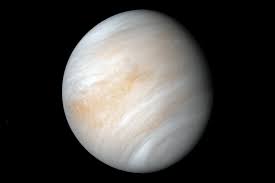
With scorching temperatures, Venus also features a hellish atmosphere that consists mainly of CO2 with clouds of vitriol and only trace amounts of water. Its atmosphere is heavier than that of the other planet, resulting in a surface pressure that's over 90 times that of Earth — almost like the pressure that exists 3,300 feet (1,000 meters) deep within the ocean.
Incredibly, however, is that early in Venus' history, the earth may have actually been habitable, consistent with models from researchers at NASA's Goddard Institute for Space Studies and other studies.
DAVINCI+ [VB2]
• DAVINCI+ is brief for ‘Deep Atmosphere Venus Investigation of Noble gases, Chemistry, and Imaging’ and is the first US-led mission to the planet’s atmosphere since 1978.
• it'll attempt to understand Venus’ composition to ascertain how the earth formed and evolved.
• This mission also consists of an honest sphere which will undergo the planet’s thick atmosphere and make observations and take measurements of noble gases and other elements.
• Significantly, this mission also will attempt to return the primary high-resolution photographs of a geological feature that's unique to Venus.
• This feature, which is named “tesserae” could also be like Earth’s continents.
VERITAS[VB3]
• The second mission called VERITAS is brief for ‘Venus Emissivity, Radio Science, InSAR, Topography, and Spectroscopy’.
• it'll map the planet’s surface to work out its geologic history and understand the explanations why it developed so differently from Earth.
• VERITAS will orbit Venus with a radar which will help to make a 3D reconstruction of its topography which could be ready to tell scientists if processes like plate tectonics and volcanism are still active there.
• This mission also will map the emissions from Venus’s surface which will help in determining the sort of rocks that exist on Venus–a piece of data that's not exactly known yet.
• it'll also determine if active volcanoes are releasing water vapour into the atmosphere.
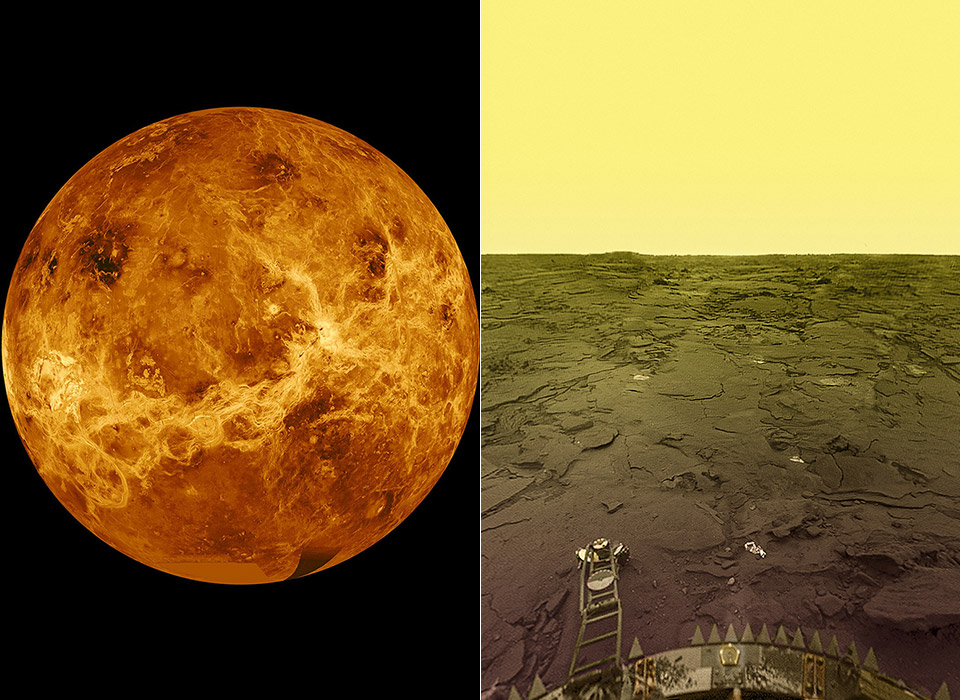
The results from DAVINCI+ are expected to reshape the understanding of planet formation within the system and beyond. Taken together, both missions are expected to inform scientists more about the planet’s thick cloudiness and therefore the volcanoes on its surface.
Further, scientists speculate about the existence of life on Venus in its distant past and the possibility that life may exist in the top layers of its clouds where temperatures are less extreme. Because of the planet’s harsh environment, no humans have visited it and even the spacecraft that have been sent to the planet have not survived for a very long time.
Mission Venus[VB4]
Venus’ high surface temperatures overheat electronics in spacecraft during a short time, so it seems unlikely that an individual could survive for long on the Venusian surface. So far, spacecraft from several nations have visited the earth . The first such spacecraft was the Soviet Union’s Venera series (the spacecraft, however, could not survive for long because of the planet’s harsh conditions). It was followed by NASA’s Magellan Mission that studied Venus from 1990-1994. As of now, Japan’s Akatsuki mission is studying the earth from Orbit. In addition to the 2 missions, NASA selected a pair of technology demonstrations to fly alongside them. VERITAS will host the Deep Space Atomic Clock-2, built by JPL and funded by NASA’s Space Technology Mission Directorate. The ultra-precise clock signal generated with this technology will ultimately help enable autonomous spacecraft maneuvers and enhance radio science observations. DAVINCI+ will host the Compact Ultraviolet to Visible Imaging Spectrometer (CUVIS) built by Goddard. CUVIS will make high resolution measurements of ultraviolet employing a new instrument supported freeform optics. These observations are going to be wont to determine the character of the unknown ultraviolet absorber in Venus’ atmosphere that absorbs up to half the incoming solar power.
NASA’s Discovery Program
Established in 1992, NASA’s Discovery Program has supported the event and implementation of over 20 missions and instruments. These selections are a part of the ninth Discovery Program competition. The concepts were chosen from proposals submitted in 2019 under NASA Announcement of Opportunity NNH19ZDA010O. The selected investigations are going to be managed by the Planetary Missions Program Office at NASA’s Marshall Space Flight Center in Huntsville, Alabama, as a part of the invention Program. The Discovery Program conducts space science investigations within the Planetary Science Division of NASA’s Science Mission Directorate. The goals of the program are to supply frequent opportunities for principal investigator-led investigations in planetary sciences which will be accomplished under a not-to-exceed cost cap.
By-Vinita Yadav
Team Lead
Clubs and Workshops
++++++++++++++++++++++++++++++++++++++++++++++++++++++++++++++++++++++++++++++
Meta Title:DA VINCI+ and VERITAS: NASA’s missions to Venus – Space India
Meta Description: DA VINCI+ and VERITAS are NASA’s latest missions to Venus. The missions look into finding out how the planet became this Hades’ Lire when it has so many other characteristics like the earth.
[VB1]Add this in Subheading.
[VB2]Add this in subheading
[VB4]Add this in H2 tag
Career In Astronomy: Eligibility, Job Opportunities &Astronomy Organisations in India
"The best way to predict the future is to create it" —Abraham Lincoln
Astronomy is a branch of science that deals with celestial bodies. It is a completely scientific observational study with advanced mathematical skills.The field has abundant career opportunities for individuals with knowledge and passion in the subject.
India has produced several excellent physicists and astronomers who have made significant contributions to space science. The era began many years ago with Arybhatta's Arya-Siddhanta, and advancement in this discipline has continued unabated since then. Some of the prominent personalities who have made the country proud include C.V. Raman, Ashok Sen, Sisir Kumar Mitra, Kalpana Chawla, and T.A. Tulsi. If these people inspire you, then you too can be a name among them. As a result, a career in astronomy opens the door to a new universe of knowledge and research.
Eligibility
Astronomy is a highly technical subject that should only be pursued by students who have a strong grasp of mathematics and physics. It is mostly an observational rather than an experimental field of research, and a thorough comprehension of the principles is required.
A student who studies physics, chemistry, and mathematics in school is eligible to pursue astronomy as a career. Master's programs are open to anyone with a B.Sc. in physics or a B.E./B.Tech in engineering who has demonstrated aptitude in the discipline. M.Sc. in Astronomy & Astrophysics is one of the post-graduate degrees available. It can be followed up with a Ph.D. program that lasts at least four years.
Job Opportunities In Astronomy
What are the career opportunities in Astronomy?
Astronomy is a fascinating field of study that provides a wide range of prospects for those with a strong aptitude for it. It is unquestionably necessary to have skills, as well as patience and knowledge. The universe is infinite, and so the scope of an Astronomy profession is vast. The face of this area has altered as a result of advancements and technological advancements.
It has aided in experimentation and study, as well as facilitated progress. However, despitethe abundance of opportunities, only the most qualified and fastidious individuals are able to shine in this sector. Individuals can work in a variety of research positions at prestigious government and private institutions. They are some of them.
Best Astronomy Organisations in India
- Indian Space Research Organisation (ISRO).
- Defense Research & Development Organization (DRDO)
- National Physical Laboratory (NPL), New Delhi
- Physical Research Laboratory (PRL), Ahmedabad
- Tata Institute of Fundamental Research (TIFR), Mumbai
- State Observatory (SO), Nainital
- Aryabhatta Research Institute for Observational Sciences (ARIES),
- Indian Institute of Astrophysics (IIA), Bangalore
+++++++++++++++++++++++++++++++++++++++++++++++++++++++++++++++++++++
Meta headline: Career in Astronomy, Eligibility, Job Opportunities – Space India
Meta description:Astronomy is a branch of science that deals with celestial bodies. It is a completely scientific observational study with advanced mathematical skills.The field has abundant career opportunities for individuals.