
DA VINCI+ AND VERITAS
The exploration of space will go ahead, whether we join in it or not, and it is one of the great adventures of all time, and no nation which expects to be the leader of other nations can expect to stay behind in the race for space.” – John F. Kennedy.
DA VINCI+ and VERITAS are NASA’s latest missions (part of NASA’s Discovery Program), to Venus. The missions look into finding out how the planet became this Hades’ Lire when it has so many other characteristics like the earth. These investigations are the ultimate selections from four mission concepts NASA picked in February 2020 as a part of the agency’s Discovery 2019 competition. Following a competitive, peer-review process, and the two missions were chosen based on their potential scientific value and the feasibility of their development plans. The project teams will now work to finalize their requirements, designs, and development plans. NASA is awarding approximately $500 million per mission for development. Each is predicted to launch within the 2028-2030 timeframe.
About Venus:[VB1]
Venus, the second planet from the sun, is known as after the Roman goddess of affection and wonder and is that the only planet named after a female. Venus may are named after the foremost beautiful deity of the pantheon because it shone the brightest among the five planets known to ancient astronomers.
In past , Venus was often thought to be two different stars, the Hesperus and therefore the daystar — that's , those that first appeared at sunset and sunrise. In Latin, they were respectively referred to as Vesper and Lucifer. In Christian times, Lucifer, or "light-bringer," became referred to as the name of Satan before his fall. However, further observations of Venus within the time show a really hellish environment. This makes Venus a really difficult planet to watch from up close, because spacecraft don't survive long on its surface.
Venus and Earth are often called twins because they're similar in size, mass, density, composition and gravity. Venus is really only a touch bit smaller than our home planet, with a mass about 80% of Earth's.
The interior of Venus is made of a metallic iron core that's roughly 2,400 miles (6,000 km) wide. Venus' molten rocky mantle is roughly 1,200 miles (3,000 km) thick. Venus' crust is usually basalt, and is estimated to be 6 to 12 miles (10 to twenty km) thick, on the average .
Venus is that the hottest planet within the system . Although Venus isn't the earth closest to the sun, its dense atmosphere traps heat during a runaway version of the atmospheric phenomenon that warms Earth. As a result, temperatures on Venus reach 880 degrees Fahrenheit (471 degrees Celsius), which is quite hot enough to melt lead. Spacecraft have survived only a couple of hours after landing on the earth before being destroyed.
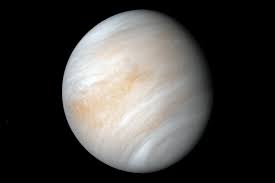
With scorching temperatures, Venus also features a hellish atmosphere that consists mainly of CO2 with clouds of vitriol and only trace amounts of water. Its atmosphere is heavier than that of the other planet, resulting in a surface pressure that's over 90 times that of Earth — almost like the pressure that exists 3,300 feet (1,000 meters) deep within the ocean.
Incredibly, however, is that early in Venus' history, the earth may have actually been habitable, consistent with models from researchers at NASA's Goddard Institute for Space Studies and other studies.
DAVINCI+ [VB2]
• DAVINCI+ is brief for ‘Deep Atmosphere Venus Investigation of Noble gases, Chemistry, and Imaging’ and is the first US-led mission to the planet’s atmosphere since 1978.
• it'll attempt to understand Venus’ composition to ascertain how the earth formed and evolved.
• This mission also consists of an honest sphere which will undergo the planet’s thick atmosphere and make observations and take measurements of noble gases and other elements.
• Significantly, this mission also will attempt to return the primary high-resolution photographs of a geological feature that's unique to Venus.
• This feature, which is named “tesserae” could also be like Earth’s continents.
VERITAS[VB3]
• The second mission called VERITAS is brief for ‘Venus Emissivity, Radio Science, InSAR, Topography, and Spectroscopy’.
• it'll map the planet’s surface to work out its geologic history and understand the explanations why it developed so differently from Earth.
• VERITAS will orbit Venus with a radar which will help to make a 3D reconstruction of its topography which could be ready to tell scientists if processes like plate tectonics and volcanism are still active there.
• This mission also will map the emissions from Venus’s surface which will help in determining the sort of rocks that exist on Venus–a piece of data that's not exactly known yet.
• it'll also determine if active volcanoes are releasing water vapour into the atmosphere.
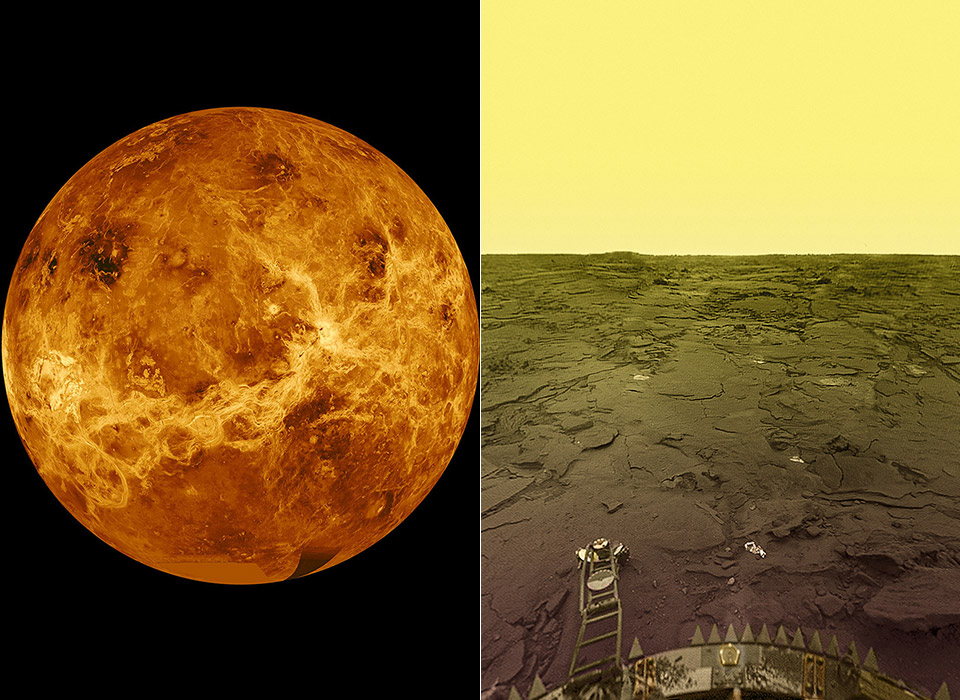
The results from DAVINCI+ are expected to reshape the understanding of planet formation within the system and beyond. Taken together, both missions are expected to inform scientists more about the planet’s thick cloudiness and therefore the volcanoes on its surface.
Further, scientists speculate about the existence of life on Venus in its distant past and the possibility that life may exist in the top layers of its clouds where temperatures are less extreme. Because of the planet’s harsh environment, no humans have visited it and even the spacecraft that have been sent to the planet have not survived for a very long time.
Mission Venus[VB4]
Venus’ high surface temperatures overheat electronics in spacecraft during a short time, so it seems unlikely that an individual could survive for long on the Venusian surface. So far, spacecraft from several nations have visited the earth . The first such spacecraft was the Soviet Union’s Venera series (the spacecraft, however, could not survive for long because of the planet’s harsh conditions). It was followed by NASA’s Magellan Mission that studied Venus from 1990-1994. As of now, Japan’s Akatsuki mission is studying the earth from Orbit. In addition to the 2 missions, NASA selected a pair of technology demonstrations to fly alongside them. VERITAS will host the Deep Space Atomic Clock-2, built by JPL and funded by NASA’s Space Technology Mission Directorate. The ultra-precise clock signal generated with this technology will ultimately help enable autonomous spacecraft maneuvers and enhance radio science observations. DAVINCI+ will host the Compact Ultraviolet to Visible Imaging Spectrometer (CUVIS) built by Goddard. CUVIS will make high resolution measurements of ultraviolet employing a new instrument supported freeform optics. These observations are going to be wont to determine the character of the unknown ultraviolet absorber in Venus’ atmosphere that absorbs up to half the incoming solar power.
NASA’s Discovery Program
Established in 1992, NASA’s Discovery Program has supported the event and implementation of over 20 missions and instruments. These selections are a part of the ninth Discovery Program competition. The concepts were chosen from proposals submitted in 2019 under NASA Announcement of Opportunity NNH19ZDA010O. The selected investigations are going to be managed by the Planetary Missions Program Office at NASA’s Marshall Space Flight Center in Huntsville, Alabama, as a part of the invention Program. The Discovery Program conducts space science investigations within the Planetary Science Division of NASA’s Science Mission Directorate. The goals of the program are to supply frequent opportunities for principal investigator-led investigations in planetary sciences which will be accomplished under a not-to-exceed cost cap.